Both COB (chip-on-board) and SMD (surface-mount device) strips are flexible PCBs with LEDs and resistors, cut to length, fed from 12 or 24 V, and stuck into an aluminium profile inside a headboard, a wardrobe, a cove or a mirror surround. On a datasheet they can be made to sound identical. In a finished room they are not, and the difference shows up in three places: whether the wall shows dots, how the strip behaves when it is bent or cut, and how hot the inside of the furniture runs. This note is the version we hand to furniture engineers who have to choose before the profile is ordered — not after the guest complains.
Two ways of putting the same light on a board
An SMD strip carries individual, packaged LEDs — 2835, 2216, 5050 — soldered in rows onto the PCB, each with its own plastic body and phosphor dome, with chip resistors between them. At 60–240 LEDs per metre, the light leaves the board as a line of discrete points.
A COB strip flips the construction: dozens to hundreds of bare LED dies are bonded directly onto the PCB in one or two dense rows (typically 320–528 chips per metre), then the whole line is flooded under a single continuous phosphor-silicone coating. There are no packages, no gaps, and no points — the coating itself is the light source.
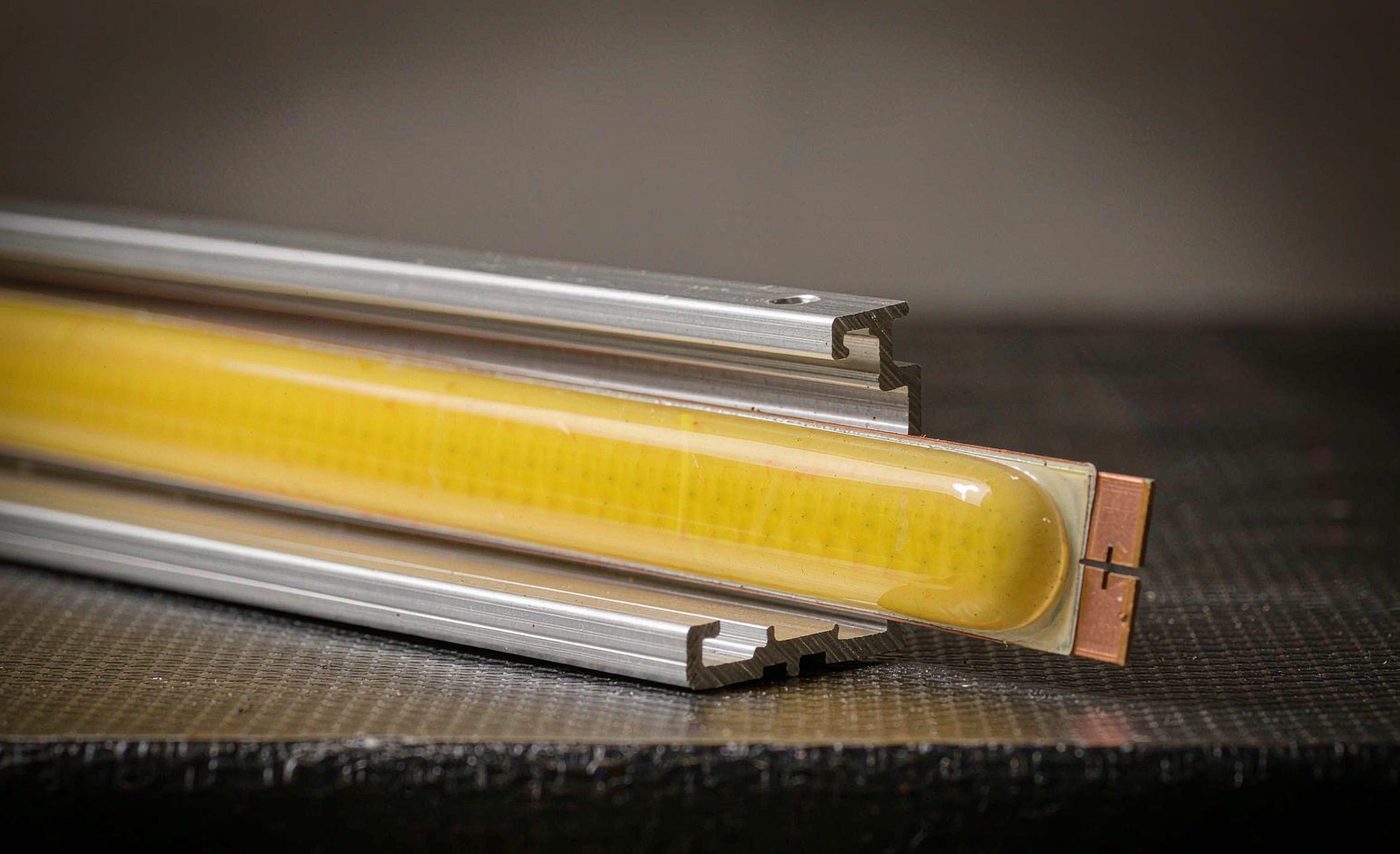
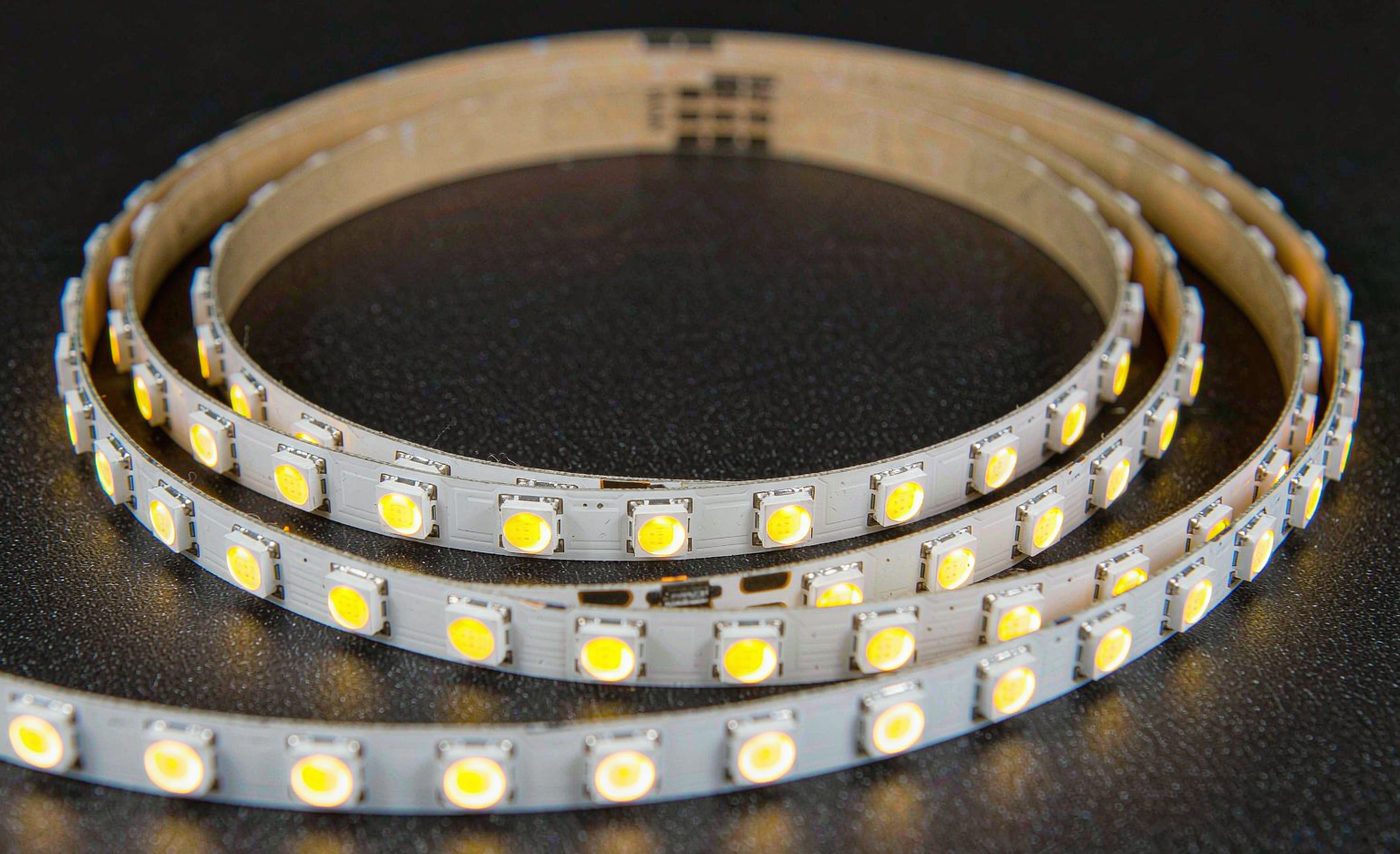
Everything else in this note follows from that single constructional difference.
The dot effect: geometry, not marketing
Point a camera at a wall lit by an exposed SMD strip and you will see a row of scalloped bright spots with dark gaps between them. This is not a defect — it is arithmetic. Each diode is a point source; the shadow of the gap between two diodes lands on the wall at a distance that grows with how far the source sits from the diffusing surface.
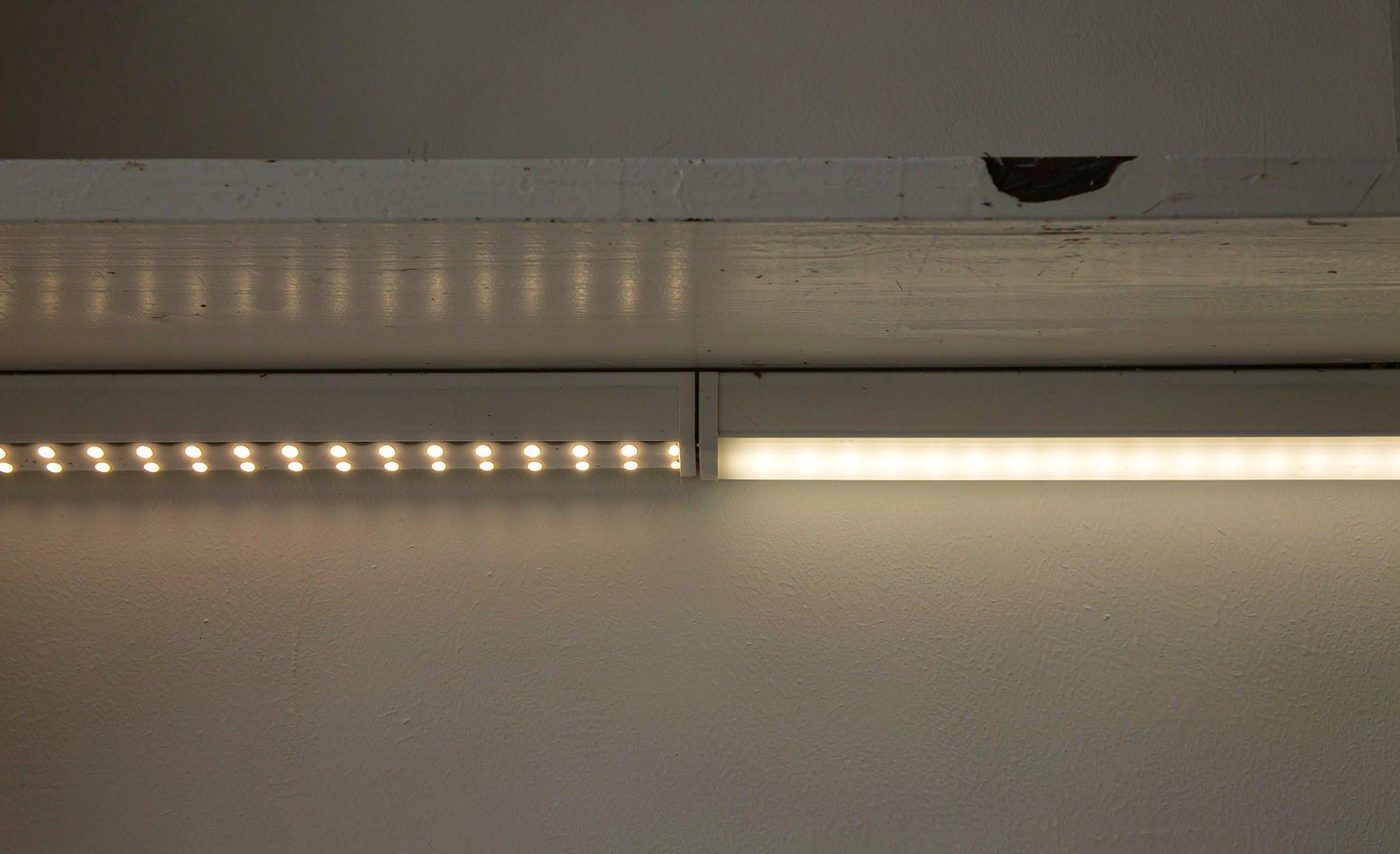
For SMD, the fix is distance. A workable rule: the diffuser must sit at least 1.5–2× the LED pitch away from the diodes. At a 60 LEDs/m pitch (16.7 mm), that means a diffuser 25–35 mm from the board; at 120 LEDs/m you can halve it. A shallow 8 mm profile with a snap-on cover 6 mm above a 60 LEDs/m strip will show dots — in a wardrobe with a glass door, at night, from the bed, every time.
For COB, the fix is not needed. With hundreds of emitters per metre merged under one phosphor layer, the strip reads as a line source even bare. Behind a diffuser it is seamless at any practical viewing distance, and in shallow profiles where a diffuser sits 3–5 mm above the board, it still looks continuous. This is why COB has taken over wardrobe and headboard detailing in the last three years: furniture profiles got shallower, and SMD could not follow.
Where dots are acceptable. In a cove 200 mm above the ceiling line, nobody sees scallops at any practical viewing angle — a good SMD strip with a decent diffuser is invisible there and costs less. Choose per location, not per project.
Cutting, bending and the details furniture actually needs
Cut points. Both types cut only at marked solder pads. SMD segments are set by the LED group — 25 mm at 12 V, 50–100 mm at 24 V depending on the circuit design. COB cut marks are typically 25 mm (12 V) to 41.7–50 mm (24 V). On furniture, cut length matters more than people expect: a 3-drawer nightstand wants a 412 mm strip, and the difference between a 41.7 mm and a 50 mm cut pitch decides whether the run ends 8 mm short of the return or 30 mm past it. Check the cut pitch against the furniture drawing before ordering, not after.
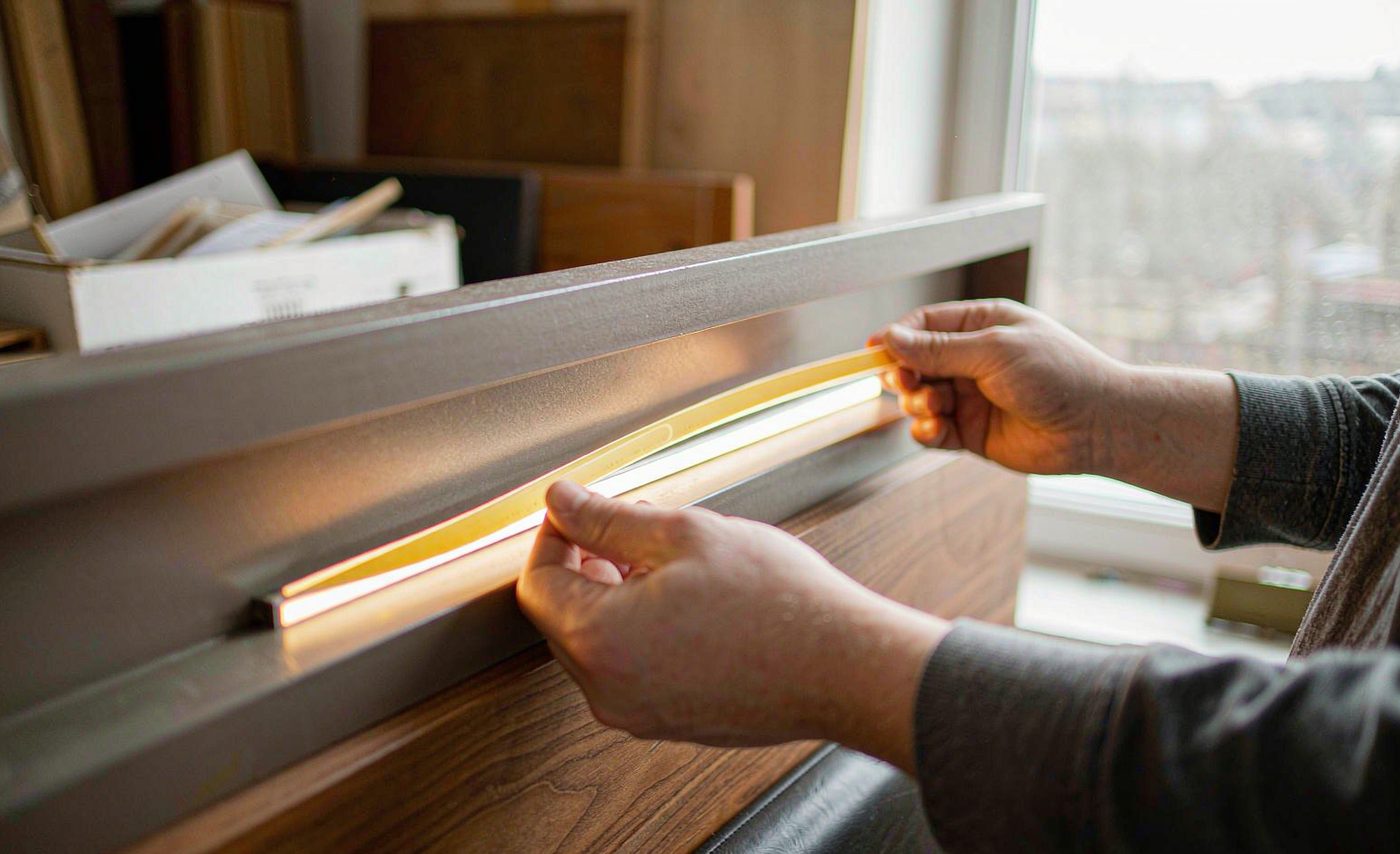
Bending. SMD strips bend only at solder joints — bend between joints and you stress the package solder until it cracks, often months later, as a dead segment. Curved headboards, round mirror surrounds and serpentine minibar reveals are exactly where this fails. COB bends continuously; a 50 mm radius curve is routine, and the phosphor coating tolerates it without cracking. For anything curved, COB is not the premium option, it is the only sane one.
Connectors and soldering. SMD pads are larger and easier to hand-solder; COB pads are smaller and sit under the coating edge, so soldering needs a hotter iron, a steadier hand, or proper click-connectors. On a factory line this is a non-issue. In a hotel fit-out where an electrician is joining strips on a ladder, it is a real one — specify snap connectors for site work either way.
Heat: the trade-off nobody puts on the datasheet
Packing more light into less PCB has a price. A COB strip concentrates the same power into a denser line, so the junction runs hotter for the same watts per metre on the same PCB — typically 5–15 °C hotter than an equivalent SMD strip. Above about 10–12 W/m, COB genuinely wants an aluminium profile, not just for looks but as a heat sink; an SMD strip at the same rating survives bare mounting more forgivingly.
The practical rules we build to:
- Up to 8–10 W/m (most headboard, wardrobe and mirror runs): either type is comfortable in a slim profile.
- 10–15 W/m (task-bright wardrobes, minibar interiors): COB in an aluminium profile with real mass, or SMD at 120 LEDs/m.
- Above 15 W/m (bright coves, high ceilings): profile mass and thermal calculation first; strip type second.
Lifetime claims follow the same logic. Ask for L70B50 at the housing temperature the profile will actually reach — not at 25 °C ambient. A strip quoting 50,000 h at 25 °C can realistically deliver 20–30,000 h sealed inside a wooden headboard at 45–55 °C. Both COB and SMD live or die by the same rule: the aluminium is the life insurance, not the LED brand.
Light quality and dimming: where the difference is small
Colour quality is a component question, not a construction question. Both types are available at CRI 90+, R9 > 50 and SDCM ≤ 3 binning; both are available badly. Do not let “COB” substitute for a proper binning specification — ask for the SDCM (MacAdam ellipse) figure in writing, because cheap COB in particular is binned loosely, and a phosphor-coated line shows colour variation along its length more obviously than discrete packages do.
Efficacy currently favours SMD at the top end: premium 2835 strips reach 140–180 lm/W, while most COB sits at 90–120 lm/W — the phosphor layer absorbs a little and the dense packing costs a little. For furniture lighting, where runs are short and heat matters more than efficiency, this rarely decides anything; for long bright coves it can.
Dimming is where COB quietly wins. At a 1–3% dimming floor, discrete SMD points do not dim perfectly uniformly — some packages sit visibly brighter than others, and the dotted scallops on the wall become more pronounced, not less. COB dims as one continuous line, so the low end stays smooth and even. In a headboard light that will be dimmed to a whisper at midnight next to a sleeping guest, this is not an aesthetic detail; it is the difference between a feature and a complaint.
What it actually costs, installed
Per metre, COB still carries roughly a 15–40% premium over an equivalent-quality 2835 strip, depending on density and binning. But strip price is rarely the installed cost. The comparison that matters:
| SMD (2835 class) | COB | |
|---|---|---|
| Strip price, per metre | 1.0 | 1.15–1.4 |
| Diffuser needed for dot-free | yes, with 25–35 mm clearance at 60 LEDs/m | optional (recommended for protection) |
| Shallowest usable profile | 10–13 mm with diffusion | 6–8 mm |
| Curved runs | poor — bends at joints only | excellent — continuous bending |
| Low-end dimming appearance | uneven below ~5% | smooth to 1% |
| Thermal ceiling (in furniture) | ~12–15 W/m bare-forgiving | wants profile above ~10 W/m |
| Efficacy (top grade) | 140–180 lm/W | 90–120 lm/W |
| Hand-soldering / site work | easier pads | prefer click connectors |
Read the table as a decision tree, not a scoreboard. A 6 mm wardrobe profile with a curved return: COB, no contest. A 300 mm cove above a ballroom ceiling: SMD at 120 LEDs/m behind a frosted diffuser, and pocket the difference. A headboard that dims to 1% every night: COB. A mirror surround in a humid bathroom: either, but IP65 construction and a real profile matter more than the chip arrangement.
Where each one goes in a guest room
- Headboard / bed wall (shallow, curved, dimmed nightly): COB, 6–8 mm profile, 24 V, 6–8 W/m, 2700 K, CRI 90+, dimmable 1–100%.
- Wardrobe interior (shallow, glass doors, close viewing): COB or 120+ LEDs/m SMD behind a diffuser; sensor switching; mind the hinge side for cable routing.
- Nightstand and desk (close-range task): SMD at 120 LEDs/m behind a good diffuser is fine and cheaper; COB if the profile is under 10 mm.
- Mirror and vanity (humid, close viewing): either type inside a sealed IP44/IP65 profile; COB gives the cleaner halo that guests photograph.
- Cove and ceiling reveal (distant viewing, long runs): SMD at 120–240 LEDs/m with diffuser — the cost saving over 100 m of cove is real, and no guest sees dots from 3 m below.
- Minibar / drawer interiors (tight, curved, battery or 24 V): COB — shallow profiles and continuous bending around corners.
One system note that outranks all of the above: specify 24 V, not 12 V, wherever runs exceed about 2 m. Voltage drop, not strip construction, is what makes one end of a wardrobe dimmer than the other.
The specification checklist
Before the profile order goes out, these ten lines are worth more than any sample approval:
Specifier's checklist
- Strip type chosen per location, not per project
- 24 V system; voltage-drop calculation for every run over 2 m
- SDCM ≤ 3 binning and CRI/R9 figures stated in writing, for both types
- Cut pitch checked against furniture drawings before the profile is ordered
- Diffuser clearance ≥ 1.5–2× LED pitch on any SMD run visible to guests
- Aluminium profile specified by mass (not “aluminium profile”) for runs above 10 W/m
- L70B50 quoted at housing temperature, with the profile, not at 25 °C ambient
- IP44/IP65 construction for anything in a bathroom zone
- Click connectors for site joins; soldered joints in the factory only
- Lowest dimming level measured and accepted on a sample, in the actual profile
Questions we get asked
Can COB replace a diffuser completely?
Why does my SMD strip show dots even with a diffuser?
Is COB always better than SMD?
Do COB strips last as long as SMD?
Can I mix COB and SMD on the same 24 V driver?
What width and voltage should furniture strips use?
Send the furniture drawing. We will answer with a lighting solution.
Cut-out drawings, photometric files and samples for the lines that fit your detail.
Request a Quote